Posted by Michael on May 02, 2012 at 01:46 PM
It’s a safe bet to describe Newcastle-residing Tom French as an image-maker and not simply just as an artist since his work doesn’t only touch a huge variety of different topics and motifs, but also executed with such diverse tools as stencils, charcoal, spray paint, collages, chamois and whatnot. What holds his body of work—a mix of urban and traditional fine arts that always seems to hold a narrative depth underneath its impressive surface together however—is his love for photo-realism as well as his ability to perfectly capture motion and dynamics in his images.
Tom, you graduated from the Sheffield Institute of Art & Design in 2005. I was wondering if your topics back then had already touched similar grounds compared to your current work or if you’ve drastically shifted your focus over the last years in particular?
At University I studied graphic design, so although not being “art” based, the course was completely creative focused, which gave me a great insight into clear creative thinking and processes, reading/understanding visual language and communicating ideas, messages and emotions.
So the topics I covered back then were very different to now. Whereas in a design sense the subject matter would have prescribed, as a visual problem to solve, I now have complete freedom to explore subjects/images I find most interesting and exciting. As for my own visual voice, I don't think I have found it yet—in-fact I hope that finding it will be a good long way in the distance. I enjoy experimenting with new techniques too much, playing with relevant visual styles/mark-making/ideas and progressing my craft. At the minute I spend more time doing this than focusing on finished works, which keeps me both busy and happy.
Did you move back to Newcastle after you’ve graduated or did you end up in London like so many artists before you?
I did spend a good few months in London straight after graduating, until I'd had enough of the high prices and spending every morning crushed onto the tube with a strangers armpit in my face! Of course London does have a lot of good points, and when I fancy a visit it's really not that far, but Newcastle is home. I like having a little more space and the lower prices mean I can have a great studio and essentially a lot more time to spend there. There's more than enough going on up here to keep me entertained, yet not too much to distract me from painting time.
The competition particularly in the UK in terms of graphic design and [contemporary] art is pretty insane. Would you consider that being challenging in a rather positive way or can it be pretty counterproductive as well? Or does it not affect you and your work at all?
To be honest the competitive side of things doesn't affect me or my work in the slightest, the only thing I'm in competition with is myself (who can be a competitive bugger at times!) Of course the high standard of work in the creative fields is massively inspirational, and seeing work I admire and engage with is a great motivator to create things which will I hope have the same effect on others.
How come your world is dominantly a monochromatic one?
There's a lot of reasons for my use of monochromatic images, although it was never an conscious decision for most of my work to be as such. Black and white images can have a certain strength, and are in many ways more powerful and effective. Charcoal drawings have a great purity and rawness, which I'm looking achieve a sense of in the most recent oil paintings. Maybe they have a timeless quality, and also a cinematic, film noir feeling with particular relevance to the skulls, reinforcing the feeling that the scene is a small part of a greater story. I recently read an Eric White interview where he summarized the subject perfectly, as follows: “The use of black and white is for me a symbolic representation of our limited perception of our surroundings. We can understand the difference between black and white and color, but what exists beyond color? Just because we can’t perceive it doesn’t mean it isn’t there. Have you ever tried to talk to a dog about the existence of color? It’s very frustrating.”
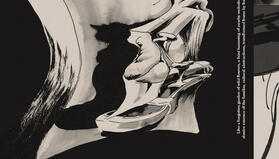
I think it’s safe to say you’re best known for the skulls you draw, which almost work as an optical illusion as well. I was fairly surprised about the Cowboy Balance series you did recently. Please tell me the story behind this project; were you fascinated by the possibility to express a certain kind of dynamics in the first place?
I had created a few of the Cowboy images before I drew the first skull illusion, and had always intended to re-visit and expand this series. So after working on something as technically difficult as the skulls it was a joy to create these cowboy images. As for the reasoning behind this project, on an aesthetic level I was looking to explore a strong sense of movement through the combination of abstract mark-making with technical realism, though of course the dynamics go further than the aesthetic. The contrast in styles between the animal and rider exaggerates the power/control struggle, it emphasizes the beauty and power of the animal, at the same time reflecting the bold, brash and seemingly careless attitude of the rodeo rider. I also wanted to put the focus on the animal rather than the rider, just tip the balance a little. This series isn’t really about cowboys or beasts, its more a small observation of the fun us people find in trying to control and own things of natural power and beauty, the perils/dangers of doing so, the boisterous and clumsy attitude we take to it, and the thrill of the ride.
I was recently asked if the series would be extended to cover other similar sports such as Spanish bullfighting, and drew some interesting conclusions which helped clarify and justify the series. One of the reasons I find the rodeo subject interesting is that the rider will rarely tame the animal, it's generally a case of hanging on as long as possible (the main priority is just to stay on for longer than eight seconds), and the chances of taming the animal are pretty slim, so in one sense it appreciates the natural power of the beast. Whereas with bullfighting the animal will rarely even survive, and the only way the matador will be injured is if something goes wrong; for me it’s far too staged and unbalanced too be of interest. I also read that many rodeo riders end up suffering from incontinence and impotence, which is pretty damn ironic for such a masculine activity.
How come you mainly use female figures to create your skulls? I guess that’s no accident, right?
Well, the new skull pieces use both male and female characters. I had previously been working on a lot of female based portrait work, so it seemed like a natural progression from this to use females in the skull images. I've heard a lot of different interpretations of these female figures, which although being interesting weren't necessarily relevant to my reasoning behind the work. Of course these images are (amongst other things) relationship based, looking at human interaction and intensity, but for me this is not gender specific, it's up to the viewer to or create or take from it their own story/reading or personal relevance.
You seem to be influenced by a lot of different styles: psychedelic imagery, photorealism, comic art, Victorian imagery—how did these influences enter your life? Family? Movies? Studies?
Ever since childhood I've always been surrounded by a wealth of imagery—my father's an artist. I was taken to galleries from a young age, encouraged to draw and paint, got lost in comic books and to this day I try to absorb myself in anything of visual interest; I can't fit any more books or magazines onto my shelves at the minute and enjoy a daily blog trawl. A good range of reference points definitely helps to keep things interesting and I hope is reflected through the work being relevant on various levels.
What are the cards holding for Mr. French in 2012?
My main goal for 2012 is to put together a few strong bodies of work and to exhibit. After so much experimentation with various techniques and images over the last few months (oil painting is relatively new to me) its’ great to finally be in the position to put this all into play and pull it together.
I'll be kicking off with a January show in London, based around and progressing the skull series. Details are still to be confirmed, so if you'd like to be kept up to date get subscribed to my blog here: www.tomfrenchart.com
words: Forty